A laser welding beam stays dangerous to your eyes over a surprisingly long range, and the figure that defines said range is the Nominal Ocular Hazard Distance (NOHD): the calculated distance from a laser source where the light intensity (irradiance or radiant exposure) drops below the level considered safe for the human eye. For a handheld welding laser, that distance is not a few careful steps back from the bench but often 100 to 280 metres or more (depending on the model), so understanding it is the foundation of any serious laser welding safety plan.
The fine line between hazard and safety
Every laser has a point along its beam range where the danger to your eyes formally ends, and NOHD marks exactly that. Within the NOHD, a direct or reflected beam can cause permanent eye injury. Whereas beyond it, the direct beam falls below the eye’s Maximum Permissible Exposure (MPE) limit. What’s the MPE? It’s the highest level of laser radiation to which an individual may be exposed without causing biological damage to the eyes or skin.
Because the NOHD number tends to be large, “just stand back a bit” isn’t a safety strategy that works with these laser machines. The rest of this guide follows from that single fact.

Why NOHD matters so much with handheld welding lasers
The hazard is made worse by something you cannot rely on: your own reflexes. Fiber-laser light sits at roughly 1064 to 1080 nm, which is invisible. So, there is no flash to trigger your blink reflex, and by the time there is any sensation at all the retina is already burned. That absence of warning is what makes the invisible beam so unforgiving compared with the visible arc you may be used to.
The intensities involved are hard to picture until you put a number on them. According to our internal calculations, a 2 kW handheld beam viewed from one meter away can put roughly 20,000 times the intensity of a 100 W light bulb onto your retina, which explains why the injury is instant rather than gradual. Every handheld welding laser that can do that kind of damage is a Class 4 laser, the highest hazard classification there is, which means the direct beam, its reflections, and its scatter, must be controlled rather than merely respected.
How to calculate nominal ocular hazard distance for laser devices?
NOHD isn’t a mysterious figure; it comes out of a formula driven by three inputs, and once you understand what each one does, the behavior of the number stops being surprising. The formula, as the safety standards express it, is:
NOHD=1/θ √((4∙P)/(π∙E_MPE ))
The first driver is laser power (P), since more watts push the hazard distance farther, though the effect grows with the square root of power rather than linearly. The second is beam divergence (θ), which describes how quickly the beam spreads. So, a tighter beam with lower divergence stays dangerous farther out and produces a larger NOHD. The third is the EMPE, the eye’s exposure limit intensity. Our NOHD Calculator works with the “optimum worst case” of 10 s for the exposure time (ANSI Z-136.1) which leads to an EMPE of around 50.6 W/m².
Here is the part that catches most people off guard
It runs against intuition, but: better beam quality actually increases NOHD. Since a cleaner, tighter beam carries its energy farther before spreading out, THEO’s MA1 ULTRA, which has the tightest beam at around 21.8 mrad, also has the longest hazard distance at roughly 325 meters on the EU basis. The very quality that makes the beam weld beautifully is the same quality that makes it reach farther, so precision and hazard distance rise together.
NOHD versus NHZ: a mono-dimensional parameter against a three-dimensional zone
If the NOHD is your headline number, and it’s a single distance measured straight down the beam axis, it answers only the question of how far the direct beam stays hazardous. By contrast, the Nominal Hazard Zone (NHZ) is the full three-dimensional space in which direct, reflected, or scattered radiation exceeds the MPE, and that zone is what defines your laser danger zone. This difference matters because reflections behave very differently depending on the surface. A shiny, specular reflection can stay hazardous nearly as far as the direct beam, so a polished workpiece or a stray tool can effectively redirect the danger, while a matte, diffuse reflection scatters the energy, and its hazard distance is therefore much shorter. Your laser danger zone, including its walls, curtains, and every reflective surface within it, has to account for the whole NHZ rather than NOHD alone.
How far, really? A machine-by-machine comparison
Whatever brand or wattage sits on your bench, the honest answer is the same: the beam outruns any room you would ever weld in. So, don’t look at the distance, but at containment measures.
Put on the same fair basis, the point becomes unavoidable: every Class 4 welding beam reaches far, and none of them qualifies as a low-hazard tool. The table below shows NOHD computed for each machine under the 10 s exposure time eye MPE of 50.6 W/m², which lets you compare them one-to-one.
| Machine | Power | NOHD (10 s) |
| THEO MA1-35 | 800 W | 116 m |
| THEO MA1-45 | 1200 W | 145 m |
| THEO MA1-65 | 1500 W | 178 m |
| THEO MA1 ULTRA | 2000 W | 275 m |
| LightWELD 1500 | 1500 W | 115 m |
| LightWELD 2000 | 2000 W | 185 m |
| MetalFab 1200 | 1200 W | 166 m |
These are THEO calculator estimates from each machine’s rated power and divergence, and vendor data sheets may differ slightly because they use their own power and beam assumptions.
Even the smallest machine on the list clears 100 meters (about the length of a football pitch), and one of the strongest reaches well past 250 m.
Bringing a hundreds-of-metres hazard down to a workable room
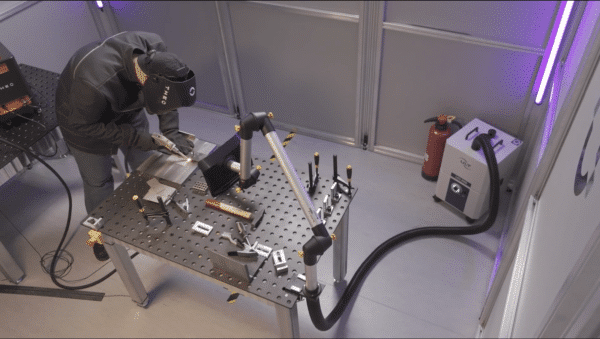
Since you cannot realistically move over 100 meters away from your own weld, you enclose the beam instead, and a properly built laser enclosure, PPE and Laser Controlled Area reduce that hundreds-of-meters hazard into a space you can work in safely.
Four measures do the heavy lifting, and they work together rather than individually.
- Enclose the NHZ. Walls, laser-rated curtains, or barriers contain the beam along with its reflections and scatter, and the barriers themselves should be tested to EN 60825-4, meaning they are rated to stop a 1080 nm beam rather than merely block visible light.
- Wear OD 7+ eyewear. Everyone inside the controlled area needs eyewear rated for 1064 to 1080 nm, not just the operator, because reflections do not care who is holding the torch. Keep in mind that a powerful direct laser beam hit can still burn through unsuitable laser glasses and protection windows.
- Define and mark a laser danger zone. Restricted access, ISO 7010 warning signage at every entry, and interlocked doors or curtains wired to shut the laser down on unplanned entry keep untrained and unprotected people out, which Class 4 operation strictly demands.
- Kill reflections. Removing or shielding shiny surfaces and orienting the beam toward a beam stop or a non-reflective backstop shortens the hazard where it would otherwise travel farthest.
Because the NOHD, according to THEO calculation across the aforementioned machines, is from 116 to 275 meters, the enclosure has to be sized to contain the beam, its reflections, and its scatter within those limits, which is precisely why the NHZ, and not the headline NOHD, is the figure your room is built around.

Hold on a Second!
THEO Academy is your go-to resource for laser welding safety knowledge. It’s designed for both THEO welders and the broader welding community to learn essential safety practices efficiently.
With THEO Academy, gain quick access to expert guidance that enhances your skills and ensures a safe welding environment. Stay sharp, stay safe. THEO Academy makes it easy.

What’s optical density (OD)?
Optical Density (OD) in laser safety describes how much laser radiation at a specific wavelength is attenuated by a protective filter or material.
Why Optical Density Difference between US and Europe
In the US, you have the ANSI Z136 standard. Even though it considers several factors including laser wavelength, exposure duration, beam characteristics, and biological impact to the eye and skin, the OD expresses a pure attenuation figure. It’s calculated as: OD = log₁₀(Emax/EMPE). (OD 6+ means that 99.9999% of transmissions are blocked.)
The EU standard EN 207 goes further. It uses a scale number (LB) that requires filters and frames to survive a direct beam hit for 5 seconds (continuous wave) or up to 50 pulses without melting, cracking, or letting dangerous radiation through. So, a CE marking certifies both attenuation and damage resistance rather than attenuation alone. This subtle but important regional difference trips people up usually. However, getting it wrong means buying eye protection that looks right on paper, but fails in practice.
Worked through for the MA1 ULTRA laser welder, whose direct-beam power density is around 8.4×10⁷ W/m², the US calculation gives an OD of roughly 6.2, which rounds up to an OD 7+ requirement, while the equivalent EU datasheet marking is 1080 D LB6, where the D denotes continuous-wave operation. An LB6 rating means the filter is both OD 6 or greater and damage-rated, and because each level step represents roughly a tenfold jump in power density, you should buy by the full EN 207 mark such as 1080 D LB6 rather than by an OD number alone.
The bottom line for a safe welding space
Once you accept that a handheld welding laser’s beam reaches farther than any room you would work in, laser welding safety stops being about caution at the bench and becomes about designing the space around the machine. That means sizing a laser enclosure to the full hazard zone, marking and interlocking it properly, killing reflections at the source, and equipping everyone inside with eyewear certified to the right standard rather than a rough OD guess.
Get Started with Laser Welding Today
THEO’s team and Partner Network can help you size your laser enclosure, choose the correct OD/LB eyewear, and specify curtains for your machine and shop layout so the whole bay is built right from the start.
Frequently Asked Questions
NOHD is the Nominal Ocular Hazard Distance, the distance from the laser at which the beam’s intensity drops to the eye’s Maximum Permissible Exposure, so that beyond that line the direct beam is below the injury threshold.
The direct beam is below the eye’s MPE beyond the NOHD, but reflections and scatter can extend the real hazard, which is why eye protection is required for everyone inside the whole laser danger zone rather than judged by the straight-line distance alone.
Power matters, yet beam divergence matters just as much, so a tighter, higher-quality beam can reach farther than a stronger but wider one; that is why NOHD is calculated from power, divergence, and the MPE together.
The two frameworks set different eye MPE values and make different exposure-time and aperture assumptions, so the stricter US eye limit of 50 W/m² produces a longer NOHD than the EU basis of 70.7 W/m² for an identical laser.
A note on the numbers: the NOHD and MPE figures here follow IEC 60825-1 and ANSI Z-136.1 methods with assumed or published divergence values, and they are estimates rather than certified measurements. They are not a substitute for the manufacturer’s laser-safety documentation or an assessment by a qualified Laser Safety Officer, so always follow your machine’s manual and your local regulations.
YOU MAY BE INTERESTED IN

TIME SAVER. THE MA1 SERIES
THEO MA1 Laser Welding Machine is a compact, easy-to-use, and highly efficient handheld laser welding system that offers superior return on invest compared to traditional welding methods.
THE ADVANTAGES OF LASER WELDING. IN YOUR HANDS
Laser welding offers a game-changing approach to joining metals, outperforming traditional methods like TIG and MIG welding in several key areas.
With laser welding, you can achieve up to 10x faster welding speeds, boosting productivity and profitability.